


 Current position > News detail
『Principle of orifice flowmeter』Related information(clamp on meter|electromagnetic meter|venturi meterrotameter|orifice meter|ultrasonic flow meter|mass flow meter|coriolis mass flow meter|coriolis flow meter|magnetic flow meter|magmeter flow meter|magflow flow meter|mag meter flow meter|electromagnetic flow meter|vortex flow meter|turbine flow meter|thermal mass flow meter|thermal flow meter|rotameter flow meter)

1. Static pressure and differential pressure of orifice flowmeter
The static pressure and differential pressure of orifice flowmeter are the core parameters for measuring flow rate. Understanding them, one can master the working principle of this flowmeter. 1. Definition and Action: Static pressure is the inherent pressure of a fluid flowing in a pipeline, which is not affected by flow velocity and reflects the potential energy of the fluid. In a horizontal pipeline, it can be imagined as the pressure exerted on the pipe wall when the fluid is at rest. Its main function is to monitor the pressure status inside the pipeline, which is an important indicator to ensure the safe operation of the pipeline system. Differential pressure refers to the pressure difference generated before and after the fluid flows through the orifice plate throttling element. Due to the obstruction of the orifice plate, the fluid velocity increases at the orifice plate, and according to Bernoullis principle, its pressure will decrease, thus forming a pressure difference. This differential pressure value is the direct basis for calculating fluid flow rate, as the flow rate is directly proportional to the square root of the differential pressure. The method of measuring static pressure usually involves opening a pressure tap on the pipeline wall and connecting a pressure sensor or gauge. The selection of this pressure point is crucial and must be located on a straight pipe section where fluid flow is stable, avoiding eddies and severe disturbances, to ensure the accuracy of data reading. To measure differential pressure, two pressure measuring points are required, located at the front and rear ends of the orifice plate, and the pressure d
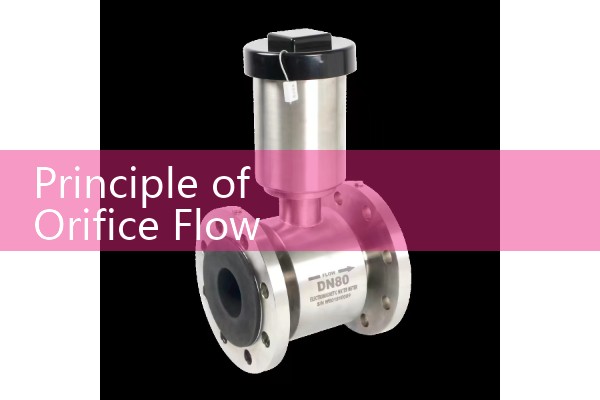
2. Working principle of orifice flowmeter
An orifice flowmeter is a device that calculates gas flow by measuring pressure difference. Its core principle is based on energy conservation and flow continuity in fluid mechanics.
. Here is a detailed explanation:1. Working principle: When gas flows through an orifice plate, due to the sudden reduction in the cross-sectional area of the orifice plate, the gas flow velocity increases significantly at the orifice, while the pressure decreases. According to the Bernoulli equation, the kinetic energy and static pressure energy of a fluid are converted into each other, and an increase in flow velocity leads to a decrease in static pressure, thereby forming a pressure difference (Δ P) between the upstream (high-pressure side) and downstream (low-pressure side) of the orifice plate. The relationship between