

『Fire Water Flow Meter Sizing: Large-Diameter Electromagnetic Sensors for Safety Loops』Related information(clamp on meter|electromagnetic meter|venturi meterrotameter|orifice meter|ultrasonic flow meter|mass flow meter|coriolis mass flow meter|coriolis flow meter|magnetic flow meter|magmeter flow meter|magflow flow meter|mag meter flow meter|electromagnetic flow meter|vortex flow meter|turbine flow meter|thermal mass flow meter|thermal flow meter|rotameter flow meter)
Fire Water Flow Meter Sizing: Large-Diameter Electromagnetic Sensors for Safety Loops
Quick Answer: Large-diameter electromagnetic flow meters from Silver Automation Instruments handle fire water loop measurement from DN150 to DN1200. They use no moving parts and hold accuracy near 0.5 percent of rate. For most safety loop sizing jobs, keep flow velocity between 0.5 m/s and 5 m/s and pick the liner based on water quality.
Fire pump rooms and fire water mains need reliable flow data. A wrong reading on a safety loop can hide a closed valve, a pump issue, or a broken pipe section. That is why many fire protection engineers now install full-bore electromagnetic flow meters on large-diameter headers. These sensors do not create pressure drop and do not jam.
Electromagnetic flow meters, also called magmeters, need water conductivity above 20 µS/cm. Most city water and fire water sources stay well above this level. Seawater used in coastal fire loops can reach 45 000 µS/cm. Silver Instruments supplies sensors with 316L, Hastelloy C, or titanium electrodes for aggressive water.
Why Large-Diameter Electromagnetic Sensors Fit Fire Safety Loops
Fire water lines often run DN200, DN300, DN400, DN600, or larger. Mechanical meters in these sizes are heavy and need frequent service. A large-diameter electromagnetic sensor has no impeller, no gears, and no bearings. The only wetted parts are the liner and the electrodes. That lowers maintenance on a line that must work in an emergency.
Here is the thing. Fire water loops can sit idle for months. When water flows, the meter must respond fast. An electromagnetic flow meter wakes quickly and sends 4-20 mA HART flow signal to the fire alarm panel or plant PLC. Some sites also use pulse output for totalized volume during weekly pump tests.
Fire Water Flow Meter Sizing Steps
Most engineers skip this part and buy a meter the same size as the pipe. That can work, but a quick check helps. First, list the pipe size DN, flow range, and pressure rating. Fire water mains often use PN10, PN16, ANSI 150, or ANSI 300 flanges. Next, check flow velocity. Electromagnetic flow meters work from 0.1 m/s to 15 m/s. The best accuracy range sits between 1 m/s and 5 m/s for fire water. Below 0.5 m/s the meter still reads but accuracy may drift. Above 10 m/s the liner wears faster on dirty water.
For a DN400 header flowing 600 m3/h, velocity is about 1.3 m/s. That is comfortable. For a DN200 line flowing only 40 m3/h, velocity is about 0.35 m/s. That is low. In practice, we size fire loop meters at 70 to 80 percent of max process flow to leave headroom for pump tests.
Water quality drives liner selection. Clean city water works well with hard rubber liners up to 80 °C. Raw water with silt or sand should use polyurethane or PTFE liners. For seawater fire loops in the Middle East or coastal Australia, choose PTFE lining and titanium or Hastelloy electrodes.
Installation and Grounding on Safety Loops
Large-diameter electromagnetic sensors need a straight pipe run for stable readings. The common rule is 5D upstream and 3D downstream from any elbow or valve. On a fire water main, the meter often sits after a butterfly valve or check valve. Grounding is also important. The sensor body must connect to pipe potential to remove stray current. For buried lines or plastic pipe sections, use g
Outputs and Power for Fire Systems
Fire safety loops usually need a 4-20 mA HART signal for flow rate. Some customers also request RS485 Modbus for building management systems. Pulse output helps with weekly test logs. Silver Instruments can provide all three outputs in one converter. Power supply options include 24 V DC and 85 to 260 V AC. For fire pump rooms, we often recommend 24 V DC with battery backup. If main power fails, the meter can continue from the fire alarm power source.
Some oil and gas terminals in the Middle East and Latin America specify ATEX Zone 1 approvals for all electrical devices in the fire zone. Silver Instruments can supply ATEX approved electromagnetic flow meters for those safety loops. Confirm the hazardous area classification before ordering.
Recommended Model and Field Example
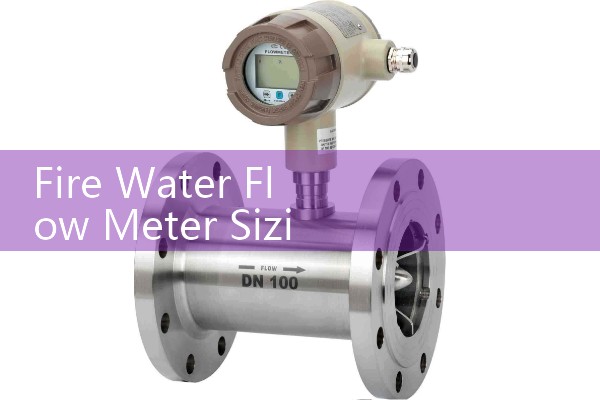
For fire water safety loops, Silver Automation Instruments normally recommends the SEF series full-bore electromagnetic flow meter. Size range covers DN15 to DN2000. Accuracy is 0.5 percent of rate or 0.2 percent depending on converter option. Liner choices include hard rubber, PTFE, and polyurethane. Electrode choices include 316L, Hastelloy C, titanium, and tantalum. Outputs are 4-20 mA HART, pulse, and RS485 Modbus. Protection class goes up to IP68 for sensor and IP67 for converter.
Last year a customer in Vietnam ordered two DN500 electromagnetic flow meters for a fire water ring main at a chemical terminal. The meters used hard rubber liners, 316L electrodes, and 4-20 mA HART output to a central PLC. The plant now runs weekly pump tests with totalized flow logs.
A desalination plant in Saudi Arabia uses a DN700 meter with PTFE liner and titanium electrodes on a seawater fire main. The flow range was 0 to 2000 m3/h. This meter has operated for 18 months with no calibration drift.
Water density for fire systems is usually taken at 998 kg/m3 at 20 °C. If the meter displays kg/h, the converter multiplies volume flow by fixed density. Electromagnetic flow meters do not depend on viscosity changes. For water at 20 °C, viscosity is about 1 cP. PT100 input is not required for normal fire water totalizing.
Frequently Asked Questions
What is the minimum conductivity for fire water electromagnetic flow meters?
Most magmeters need 20 µS/cm or higher. Fire water sources from city mains, wells, and seawater loops exceed this level.
Can I install a large-diameter electromagnetic sensor in a vertical fire main?
Yes. Vertical installation works if the line stays full and flow goes upward. Avoid downward flow with a partially filled pipe.
What output signal should I send to the fire alarm panel?
4-20 mA HART is the most common signal. Add pulse output for weekly totalized volume and RS485 Modbus for building management systems.
How do I choose between hard rubber and PTFE liner for fire water?
Use hard rubber for clean city water up to 80 °C. Use PTFE for seawater, raw water with silt, or water with chemical traces.
What information should I send for a quick quote?
Send us the pipe size DN, flow range in m3/h, pressure rating, water quality, power supply, and signal type. Contact Silver Automation Instruments. Tel: +86-25-68650347. Whatsapp: +86-25-52155837. WeChat: +86 15365082610.
 Hot News
 Related AD