

『Gf+ Signet Flow Meter Selection Guide: Matching Liquid Viscosities to the Perfect Sensor Variant』Related information(clamp on meter|electromagnetic meter|venturi meterrotameter|orifice meter|ultrasonic flow meter|mass flow meter|coriolis mass flow meter|coriolis flow meter|magnetic flow meter|magmeter flow meter|magflow flow meter|mag meter flow meter|electromagnetic flow meter|vortex flow meter|turbine flow meter|thermal mass flow meter|thermal flow meter|rotameter flow meter)
Gf+ Signet Flow Meter Selection Guide: Matching Liquid Viscosities to the Perfect Sensor Variant
Quick Answer: Liquid viscosity decides whether a GF Signet paddlewheel, magmeter, or positive displacement sensor gives stable output. Water-like fluids below 20 cP suit GF Signet paddlewheel sensors such as the 2536 or 2540. Above 50 cP, Silver Automation Instruments recommends an oval gear meter or Coriolis mass flow meter to avoid signal drift and mechanical wear.
Most engineers skip one step at the start of flow meter sensor variant selection. They focus on pipe size and flow range. Then they call us after a paddlewheel sensor gives unstable readings on polymer or syrup. That call often comes from a food plant in Malaysia or a chemical batch site in Colombia. The fluid was not water-like. Viscosity was the missing variable.
Viscosity Ranges That Change Sensor Choice
Water at 20 °C has a viscosity of 1 cP. Diesel fuel, light solvents, and most weak acids stay below 10 cP. In this range a GF Signet paddlewheel sensor works well. The rotor spins freely and the output signal stays linear. But once viscosity rises above 20 cP, the rotor can slip. The meter still gives a reading. That reading may be off by several percent because the velocity profile changes near the pipe wall.
Here is the thing. Viscosity is not a fixed number for many process fluids. It changes with temperature and shear rate. A fluid that reads 50 cP at 25 °C may read 200 cP at 10 °C. That is why we ask for the viscosity at operating temperature, not ambient temperature.
GF Signet Sensor Variants and Their Practical Limits
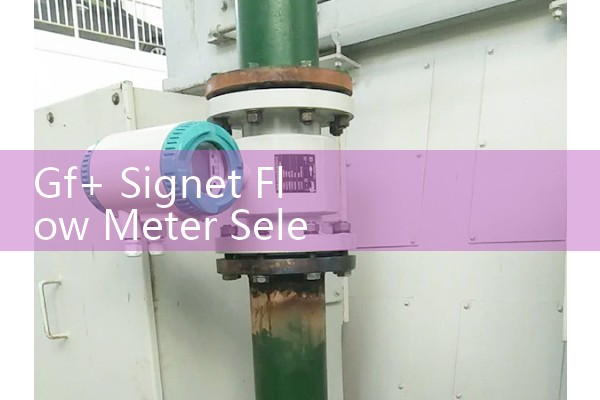
GF Signet groups its sensors into paddlewheel, magmeter, ultrasonic, and rotameter variants. The 2536 paddlewheel sensor is common on water treatment skids and cooling loops. It works from 0.3 to 6 m/s and supports DN15 to DN300 in plastic pipe systems. The 2551 magmeter handles conductive fluids with no moving parts. The 2551 magmeter tolerates small particles and works better at up to 50 cP. Above 50 cP, both paddlewheel and magmeter signals can become non-linear.
In practice, a magmeter from GF Signet or Silver Instruments is better than a paddlewheel when the stream contains small particles or when viscosity is slightly higher, up to about 50 cP. For conductive water-like fluids, an electromagnetic flow meter from Silver Instruments works from DN10 to DN3000. It is a good alternative when the line has particles or when the pipe cannot be opened for a paddlewheel. The output is 4 to 20 mA HART and the liner material can be PTFE or rubber depending on chemical compatibility.
We have seen this on customer sites many times. A paint manufacturer in Vietnam ran a resin line at 800 cP. The existing paddlewheel totalizer was off by 7 percent against the tank level. We replaced it with an oval gear meter with PTFE gears. The batch weight error dropped below 0.5 percent. Similar results happen on viscous lines in Southeast Asia and Latin America.
When to Move Away from Paddlewheel and Magmeter Sensors
For fluids above 50 cP, a positive displacement oval gear meter gives
Oval gear meters need a clean fluid. If the stream contains solids larger than 50 microns, install a strainer upstream. We have seen gear meters jam on unfiltered polymer with small carbon particles. A Coriolis meter is better for that case because the Coriolis design has no rotating parts.
Because viscosity changes with temperature, many batch processes need mass flow instead of volume flow. A Coriolis mass flow meter from Silver Automation Instruments measures mass flow and density independent of viscosity. That helps when the customer needs kg/h rather than L/min. Our Coriolis meters cover 0 to 300,000 kg/h and support 4 to 20 mA HART output. For a reactor feed line with viscosity from 100 cP to 2,000 cP, a Coriolis meter is the safest choice.
Installation Data You Need Before You Quote
Before you ask for a quote, collect the fluid name, viscosity in cP at operating temperature, flow range in kg/h or L/min, pipe size DN, pressure in bar, temperature in °C, output signal, and hazardous area classification. For hazardous areas, we offer ATEX Zone 1 versions of oval gear and Coriolis meters. Tell us the zone classification when you send the inquiry.
Send your pressure in bar, temperature in °C, pipe size DN, and flow range to Silver Automation Instruments. Call us at +86-25-68650347 or use WhatsApp +86-25-52155837. WeChat ID is +86 15365082610. Application notes are on flow-meter.com.au.
FAQ
What viscosity value is too high for a GF Signet paddlewheel?
Above 20 cP the paddlewheel rotor can slip. Above 50 cP the reading becomes unreliable for totalizing and batching. Switch to a positive displacement or Coriolis meter.
Can a GF Signet 2551 magmeter handle high viscosity?
That sensor works up to about 50 cP if the fluid is conductive. Above 50 cP the velocity profile distorts and the output may not track true flow.
Which Silver Instruments sensor replaces a paddlewheel on viscous fluid?
An oval gear positive displacement meter is the direct replacement for many viscous fluids from 200 cP to 100,000 cP. For changing viscosity or mass measurement, use a Coriolis mass flow meter.
Do I need temperature compensation for viscosity?
Yes if the fluid viscosity changes more than 10 percent within your operating temperature range. We ask for viscosity at the actual operating temperature.
What data should I send for a fast quote?
Send fluid name, viscosity in cP, flow range, pipe size DN, pressure, temperature, output signal, and hazardous area class. We select the sensor variant and send a quote.
For technical selection support, contact Silver Automation Instruments. Tel: +86-25-68650347. WhatsApp: +86-25-52155837. WeChat: +86 15365082610. Visit flow-meter.com.au for product datasheets.
 Hot News
 Related AD