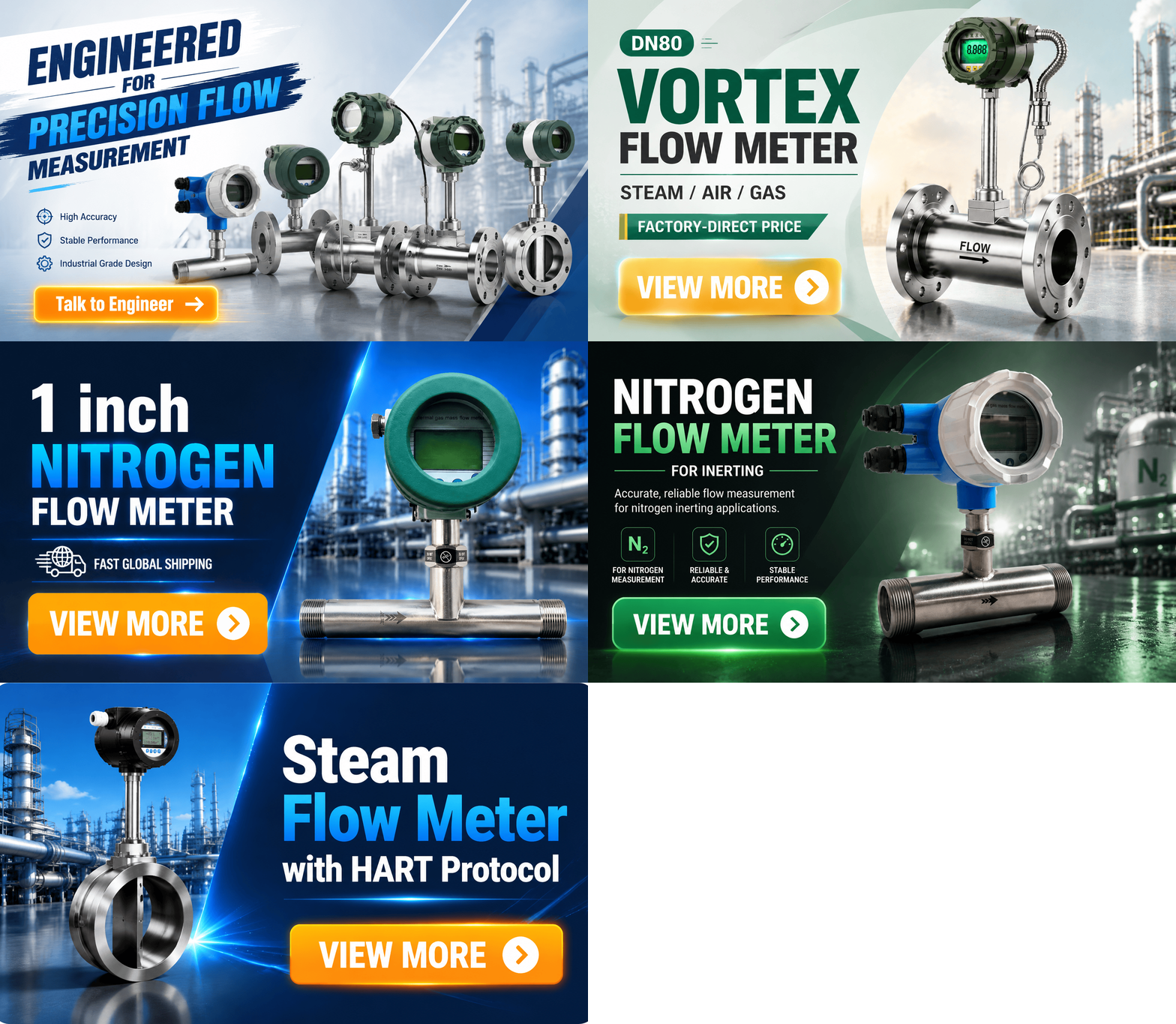


『Oxygen vortex flowmeter』Related information(clamp on meter|electromagnetic meter|venturi meterrotameter|orifice meter|ultrasonic flow meter|mass flow meter|coriolis mass flow meter|coriolis flow meter|magnetic flow meter|magmeter flow meter|magflow flow meter|mag meter flow meter|electromagnetic flow meter|vortex flow meter|turbine flow meter|thermal mass flow meter|thermal flow meter|rotameter flow meter)
1... What flow meters are good for liquid nitrogen, argon, liquid argon, hydrogen, and carbon dioxide? Common vortex street flow meters are used to measure the flow rates of oxygen, nitrogen, liquid nitrogen, argon, gas liquid, argon, hydrogen, and other gases. They have integrated voltage stabilization compensation and split display, 4-20mA signal output, and early cluster power supply for electrical modeling 2. What are the differences between vortex street and turbine flowmeter?
The difference between a vortex flowmeter and a turbine flowmeter mainly lies in their working principle, applicable medium, cost, and application scenarios, as follows:
1. Differences in working principle. Vortex flowmeter: When fluid flows through non streamlined obstacles, periodic vortices (vortex streets) will be formed behind the obstacles.
. The vortex frequency is directly proportional to the fluid velocity, and the flow rate can be calculated by measuring the frequency. The formula is: f=Kv, where f is the vortex frequency, v is the flow velocity, and K is a constant related to the shape of the object and fluid properties. Turbine flowmeter: The fluid drives the turbine to rotate, and the turbine speed is proportional to the flow rate. The flow rate is calculated by measuring the speed. The formula is: Q=KN, where Q is the flow rate, N is the rotational speed, and K is a constant related to fluid characteristics and turbine design.
2. Differential vortex flow meters suitable for resolving quality issues: liquids such as water, oil, alcohol, chemical raw materials, etc. Gases: air, oxygen, nitrogen, natural gas, coal gas, etc. Steam: saturated steam, superheated steam. Characteristics: Strong adap
III. Differences in Cost and Application Scenarios of Hebe family Vortex flowmeter: Cost: slightly higher than turbine flowmeter.
. Advantages: Simple and sturdy structure, no movable parts, high reliability. Easy installation and maintenance, wide measurement range, and high accuracy. Strong anti vibration performance, capable of filtering out interference signals. Application scenarios: Industrial pipelines, thermal systems, chemical industry. Complex working conditions in various fields such as gas, steam, and liquid. Turbine flowmeter: Cost: relatively economical. Advantage: High measurement accuracy for clean liquids. The measurement of volumetric flow rate under working conditions is less affected by fluid density, pressure, temperature, and viscosity. Application scenarios: industries such as oil, natural gas, food and beverage, pharmaceuticals, etc. Scenarios with clean fluids and low viscosity.Fourth, other differences in measurement stability: The vortex flow meter has better long-term stability due to the lack of movable parts.
. The turbine of the turbine flowmeter may be affected by wear or accumulation of dirt, which may affect its accuracy and requires regular maintenance. Anti interference capability: Vortex flowmeter has a certain anti-interference ability against pipeline Hot Blog
 Related AD